
Blockchain and Agentic Payments: Capturing the Trillion-Dollar Agentic Commerce Opportunity
20 October 2026
Taken from the published LinkedIn Pulse article.
Introduction
Agentic commerce is a fast-growing, novel field alongside artificial intelligence, built on the idea of AI agents carrying out payments, tasks and orders on behalf of clients and businesses. An AI agent is software that can be given a goal and then work out and carry out the steps needed to achieve it with little or no human input. One example is the instruction “Purchase 20 shares of tokenised AAPL shares, search for a platform with the best offers amongst my approved venues list”.
McKinsey projects that agentic commerce could account for $3 trillion to $5 trillion of global consumer sales by 2030. Capturing this value, however, depends on solving a fundamental problem, how can an agent complete a human-less transaction when it cannot open a bank account and does not hold card details?
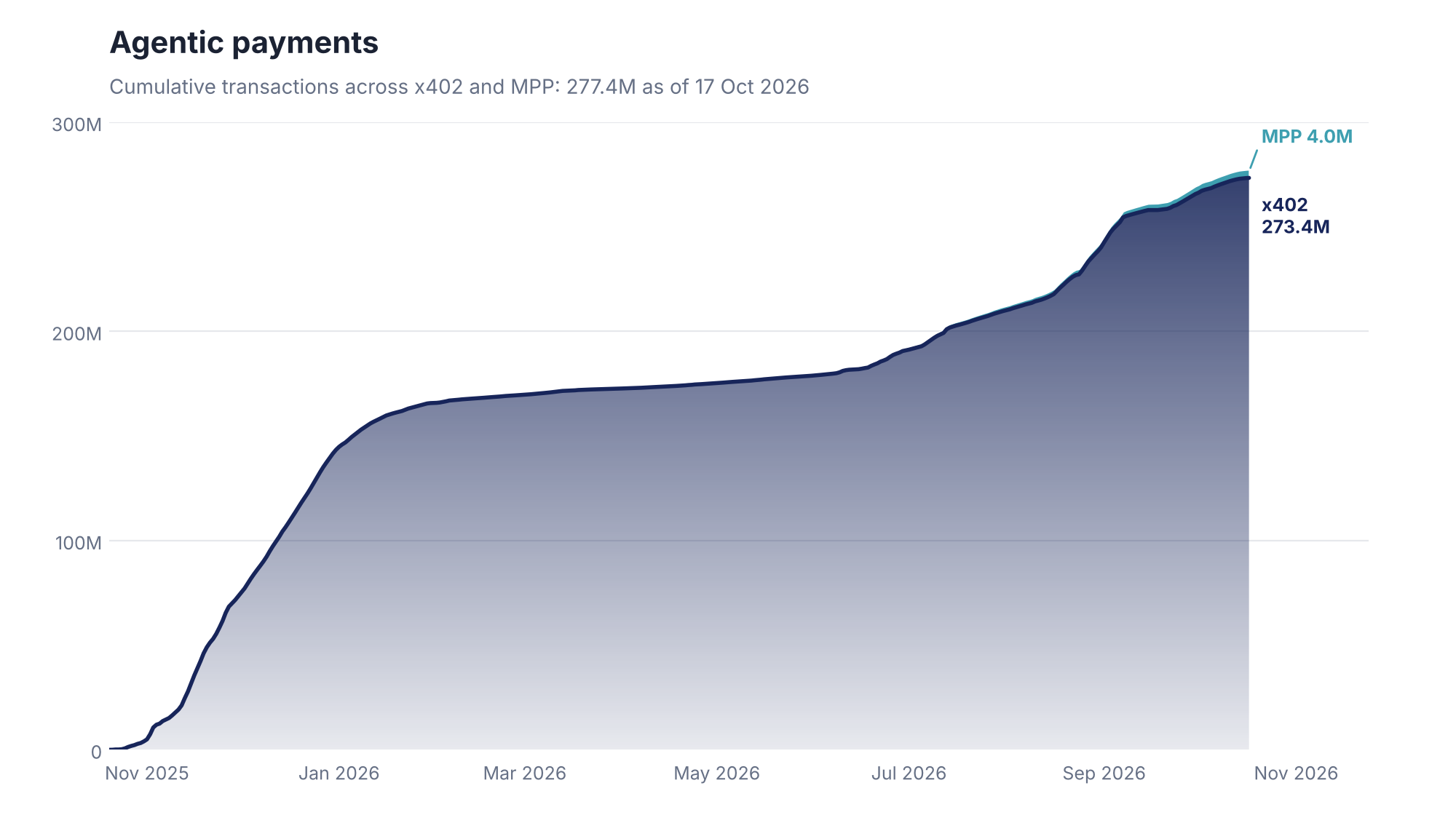
The solution is a long-dormant part of the web. The HTTP 402 “Payment Required” status code was reserved in the early days of the internet for websites to request payment before delivering content, but it sat unused for decades until last year. This unused system now serves as the foundation of agentic payments. In practice, it works in four steps: an agent requests a service, the service replies that payment is required and states the price, the agent pays, and the service delivers its product within seconds. When paired with blockchain technology, it enables agents to transact directly with services and other agents, typically using stablecoins.
This article covers what agentic payments are, why blockchain matters for them, the benefits they offer, the main use cases and how organisations can use them.
What are Agentic Payments and Why Does Blockchain Matter?
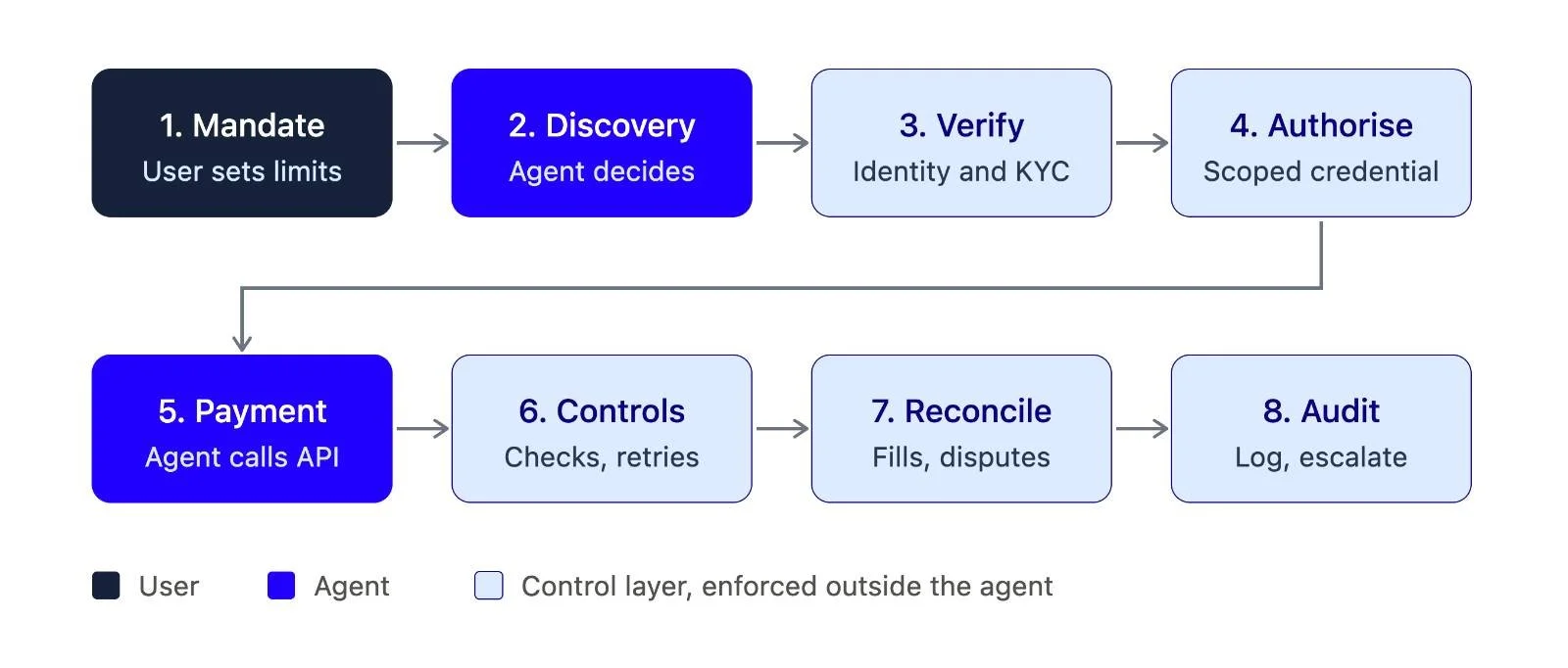
Agentic payments are payments made by AI agents to carry out automated tasks within a defined rule set. Agents are given spending authority that specifies what they may buy, from which platforms, up to what amounts and when they must obtain human approval. The agent finds, compares and pays for what it needs, with every payment recorded against the authority that allowed it. For example, a fund could give an agent a monthly budget to buy market data and the agent would pay for each dataset itself, escalating to a person only for purchases above a set limit.
Traditional payment services require a bank account and card details, which agents cannot set up on their own and should not be entrusted with. Blockchain removes this barrier and makes payments economical that would not be viable on traditional rails, while preserving the core strengths of blockchain itself: transparency, security and immutability. For example, a one-time API query may cost $0.02. Settled through a traditional payment network, it can usually incur a flat fee of $0.30, far more than the value of the query itself. Stablecoin transactions make such payments viable, with fees of a fraction of a cent (around $0.001 per transaction on Base).
The Benefits
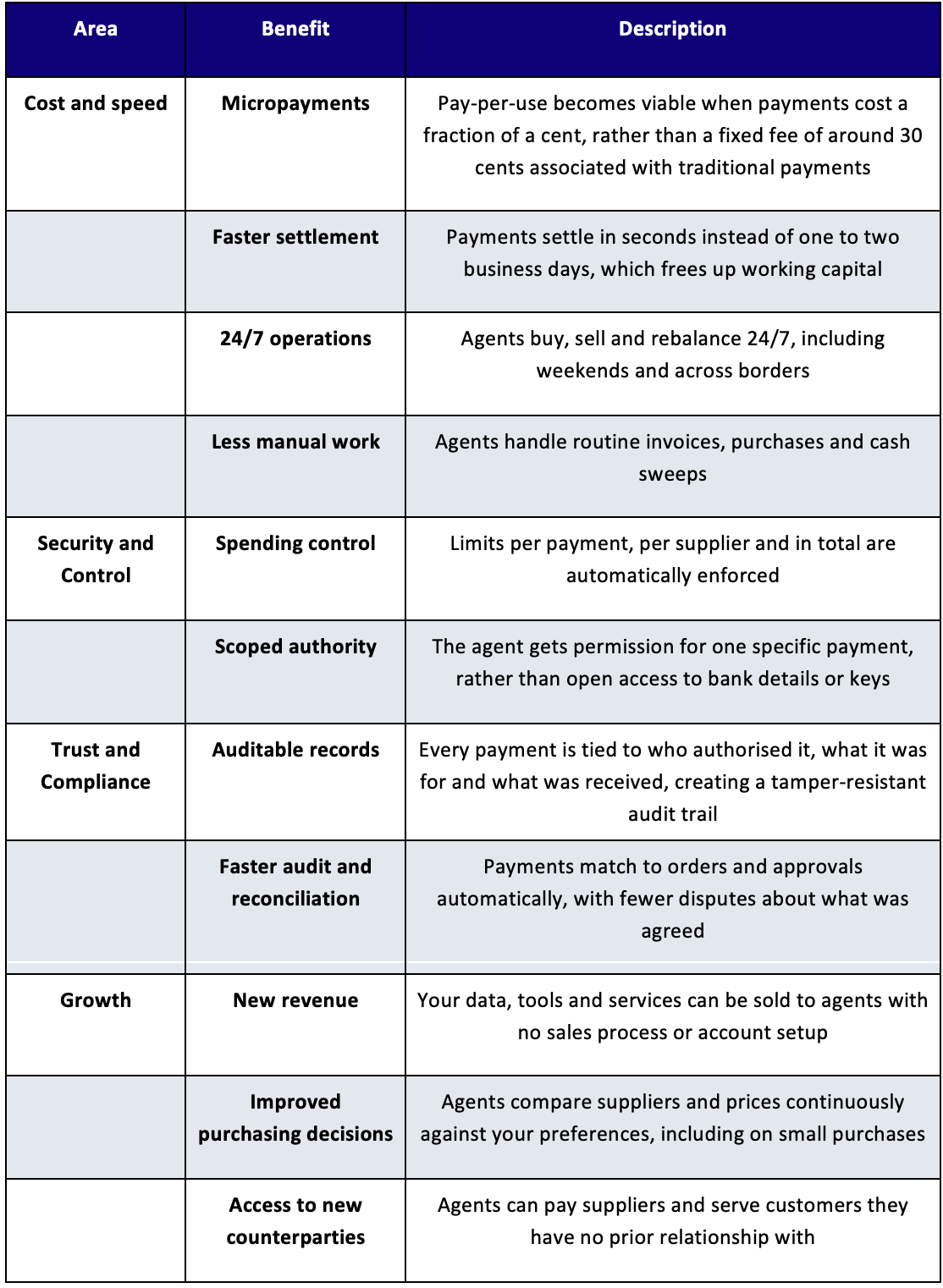
Pairing agentic payments with blockchain unlocks a range of benefits, grouped below by business function:
Use Cases
Agentic payments are seeing increased use in traditional finance and offer an opportunity to reduce friction in workflows that remain slow and manual. Through our experience with clients, Appold has identified the most prominent use cases, outlined below.
Data Procurement and Market Intelligence
Traditionally, a fund wanting market data, news analytics, alternative data or research services would have to go through subscriptions, enterprise contracts or static API keys. Agentic payments enable pay-per-query access through micropayments and stablecoins, allowing agents to call data from APIs on a per-query basis, which would not have been economically viable through traditional payments. Card transactions usually carry a flat fee of around $0.30; stablecoins allow sub-cent transactions, so an agent can retrieve and pay for data in a single API call. For data and model providers, this opportunity opens a new customer line by selling directly to agents.
Autonomous Treasury and Liquidity Management
As tokenised and crypto assets become a more prominent holding among funds, firms and institutions, the need to manage balances across bank accounts, stablecoins, custodians, exchanges and on-chain protocols is growing. Agents can automate payments to service providers, liquidity rebalancing, collateral monitoring, balance sweeping, stablecoin exposure hedging and responses to margin or liquidity triggers, 24/7 and with atomic settlement.
Tokenised Settlement and Wholesale Platforms
Tokenised deposits, funds, bonds and other real-world assets are increasingly being issued and traded on shared ledgers, and wholesale platforms are being built to settle them. Traditionally, settlement involves a gap between the two legs of a trade, with the asset and the payment moving through separate systems and taking one or two business days to settle. This ties up capital, creates counterparty risk and makes failed settlements a persistent cost.
On a shared ledger, an agent can settle a trade by exchanging the asset and the payment simultaneously, removing the gap between the two legs. Agents can also handle the operational work around settlement, including moving collateral, managing intraday liquidity and automatically matching payments to trades and approvals. Settlements can occur 24/7 on the blockchain, providing a clear audit trail of who authorised what and when.
DeFi Intent Execution
Agents can formulate a swap or collateral management intent and request quotes from ‘solvers’, specialist market participants who compete to fulfil it. Given an instruction on what to do with a party’s cryptoassets, the agent searches for the best way to do it, pays for it and keeps a record of why it chose that option. Agents can also be restricted to approved protocols and assets, held to spending limits and required to use set templates.
Agentic Trading
Agents can also execute trading strategies within a defined mandate, monitoring the market, acting on signals and settling trades. Traditionally, this kind of automation has required dedicated infrastructure, bilateral account setups with each venue and settlement cycles that leave capital idle. Agentic payments and tokenised settlement allow an agent to fund and execute trades across venues without a pre-existing relationship and settle them in seconds.
How Appold Can Help
Applying agentic payments within a financial institution requires more than technical expertise. Firms must select the most appropriate stablecoins, wallets and blockchain networks, integrate with suitable trading platforms and ensure that agents operate within robust governance frameworks and in accordance with regulatory requirements.
Moving from proof of concept to a fully operational solution is often more complex than it first appears. Appold brings experience across stablecoins, wallets, blockchain infrastructure and trading platforms, alongside the governance and regulatory requirements needed to make agentic payments work safely and effectively in a company or financial institution.
Appold is equipped to help clients with:
Identifying where agentic payments and blockchain services can add value to their business
Selecting the stablecoins, wallets, chains and infrastructure that fit their needs
Connecting to trading platforms and wholesale venues
Building governance, spending controls and approval structures for agents
Meeting compliance and regulatory requirements and preparing for supervisory engagement
If your business is interested in how agentic payments and blockchain services could apply to your operations, please contact us at info@appold.com.