Appold Market Watch - Week ending 1 May 2026
Market Update and Industry News - Week Ending 1 May 2026
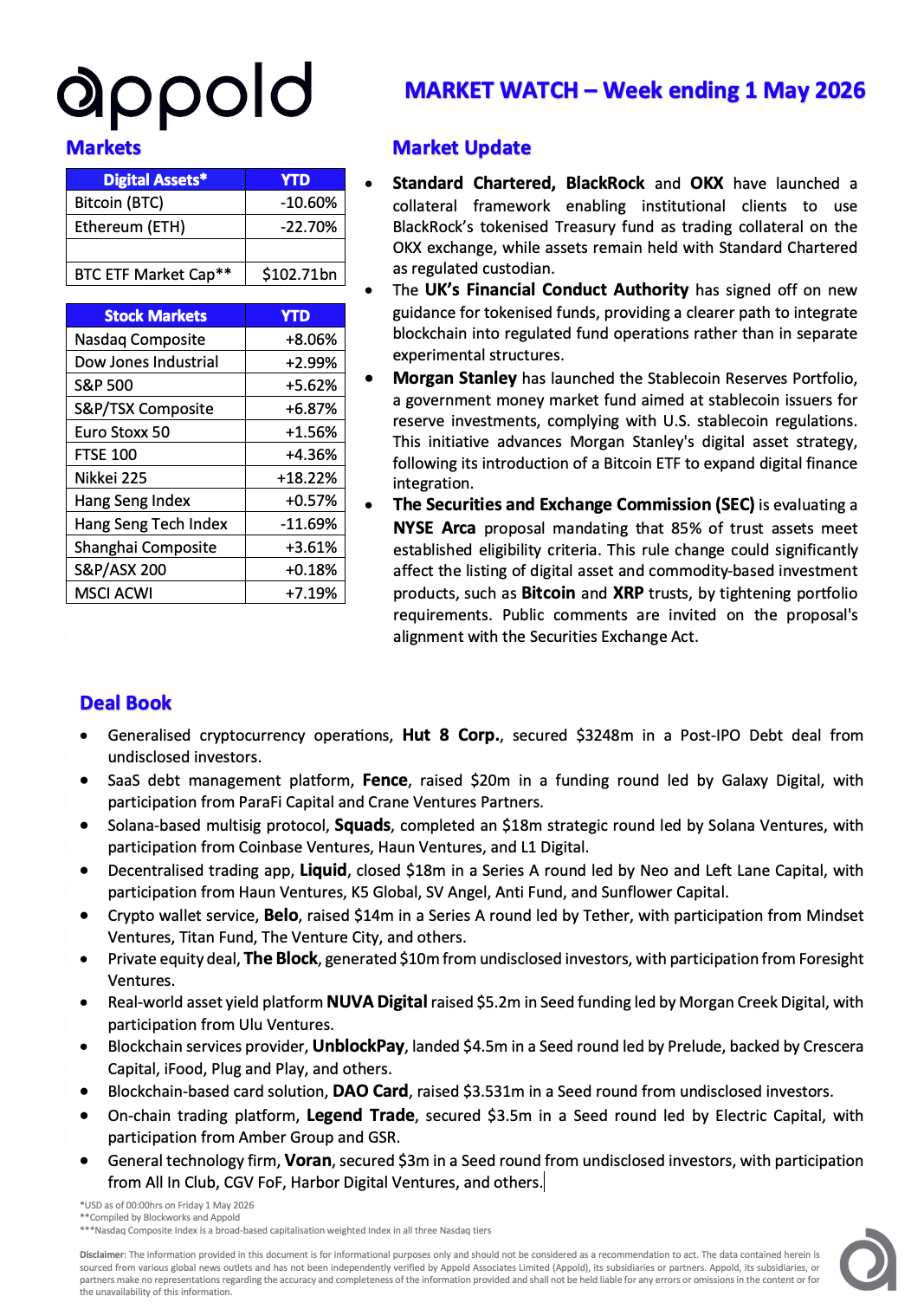
🔷 Standard Chartered, BlackRock and OKX have launched a collateral framework enabling institutional clients to use BlackRock's tokenised Treasury fund as trading collateral on the OKX exchange, while assets remain held with Standard Chartered as regulated custodian.
Appold view: This is very positive as it represents significant progress in the gradual harmonisation of digital and traditional asset classes. The key development is the operating model, which is moving tokenised assets closer to real trading, margining and liquidity workflows within an institutional custody framework.
🔷 The UK’s Financial Conduct Authority has signed off on new guidance for tokenised funds, providing a clearer path to integrate blockchain into regulated fund operations rather than in separate experimental structures.
Appold view: The FCA guidance is helpful, but remains cautious. It supports tokenised funds within the existing regulatory perimeter, but falls short of a decisive push towards scalable market adoption. The real test is whether guidance now translates into robust operating standards capable of supporting market growth.
🔷 Morgan Stanley has launched the Stablecoin Reserves Portfolio, a government money market fund aimed at stablecoin issuers for reserve investments, complying with U.S. stablecoin regulations. This initiative advances Morgan Stanley's digital asset strategy, following its introduction of a Bitcoin ETF to expand its integration with digital finance.
Appold view: The move shows how stablecoin regulation is creating a new institutional liquidity opportunity. As stablecoins become part of financial infrastructure, reserve management is becoming less a crypto-native function and more a regulated asset-management market.
🔷 The U.S. Securities and Exchange Commission (SEC) is evaluating a NYSE Arca proposal mandating that 85% of trust assets meet established eligibility criteria. This rule change could significantly affect the listing of digital asset and commodity-based investment products, such as Bitcoin and XRP trusts, by tightening portfolio requirements. Public comments are invited on the proposal's alignment with the Securities Exchange Act.
Appold view: It’s always a balancing act to tighten standards without eliminating product flexibility, and this proposal points to a more disciplined listing environment for digital-asset trusts. The 85% threshold is notable for being high enough to enforce eligible core exposure but flexible enough to allow practical portfolio management around the edges.