
Canada’s Stablecoin Framework: Key Requirements and What Comes Next
28 October 2026
Taken from the published LinkedIn Pulse article.
Introduction
As global demand for stablecoins grows and their use expands beyond crypto trading, particularly into cross-border payments, jurisdictions worldwide are considering how best to regulate this emerging asset class. Canada is among them, with the federal government opening a public consultation this week on its draft stablecoin regulations.
Canada currently has no federal framework in force governing stablecoin issuance. While provincial securities regulators oversee which stablecoin trading platforms may list, their remit does not extend to a nationwide issuance regime. A lack of a national oversight and governance framework creates risks for consumers and reduces the regulatory clarity required for innovation.
The Department of Finance Canada has been developing a federal stablecoin framework since launching targeted engagements on the regulatory approach for stablecoins in late 2024. The Canadian federal Stablecoin Act (S.C. 2026, c. 3) was enacted on 26 March 2026, laying the legislative foundation for this regime. Draft regulations were published on 24 October 2026, setting out the operational details needed to bring the Act into force. A 60-day public consultation is now open on these proposed regulatory requirements, with the regulations provisionally targeted for commencement in autumn 2027, subject to consultation and finalisation.
This article sets out what Canada’s Stablecoin Act and its proposed regulations do, outlines their key requirements, compares them with the U.S. GENIUS Act, and explains how the consultation works and why taking part matters.
What the Stablecoin Act Does
The Stablecoin Act aims to give Canadians a safer way to hold and use fiat-backed stablecoins, particularly for payments within a defined regulatory perimeter, while giving issuers clear rules to operate under. The Act applies to stablecoins with interprovincial or international applications that are issued or made available for purchase by persons in Canada and designates the central bank, the Bank of Canada, as their supervisory authority.
The Department of Finance has set out three public policy objectives, summarised below:
● Competition, Innovation and Economic Growth: Create a regulated space for issuance of fiat-backed stablecoins in Canada, with clear rules for issuers and payment service providers.
● Consumer Protection: Ensure clear requirements for redemption, with properly managed reserves.
● Safety and Soundness: Reduce the risk of runs and de-pegging events and allow the government to screen issuers for national security risks.
Reserves and Custody
Issuers must hold reserves at least 1:1 to the stablecoins outstanding, measured at the end of the day. Permitted reserve assets are demand deposits, debt securities issued by the government of a country with a remaining maturity of 3 months or less, one-business-day reverse repos backed by short-dated government debt, and money market funds composed entirely of eligible reserve assets, including reference-currency assets, demand deposits, short-dated government debt and eligible one-business-day reverse-repo assets. Reserves must be held in segregated, bankruptcy-remote accounts at a Canadian-incorporated qualified custodian. Issuers are allowed to withdraw returns from the reserve to the extent that the reserve remains at least equal to the par value of outstanding stablecoins.
Redemption
Holders can redeem at par, with no minimum amount, within three business days. Redemption fees are capped at 1%, and issuers must give seven days’ notice of any increase in fees. Issuers are allowed to limit daily redemptions only where liquidity shortfalls in the reserve-asset markets prevent them from meeting redemption requests.
Yield
Issuers cannot pay interest or yield linked to holding a stablecoin, whether directly or through arrangements with third parties, including income-sharing. Rewards tied to using a stablecoin, rather than holding it, are allowed.
Governance and Reporting
Issuers must maintain written governance, risk management, data security, and recovery and resolution policies. Each requires a responsible senior officer, an annual review and a bilingual public summary, and the risk management and data security policies need independent review every three years. Issuers must file monthly reports to the Bank of Canada, including an accountant’s opinion on reserves, and keep records for five years.
Enforcement
The Bank of Canada would supervise issuers and could impose penalties of up to C$1 million for ‘serious’ violations and up to C$10 million for ‘very serious’ violations, such as failing to maintain reserves or to redeem at par.
How the Stablecoin Act Compares with the U.S. GENIUS Act
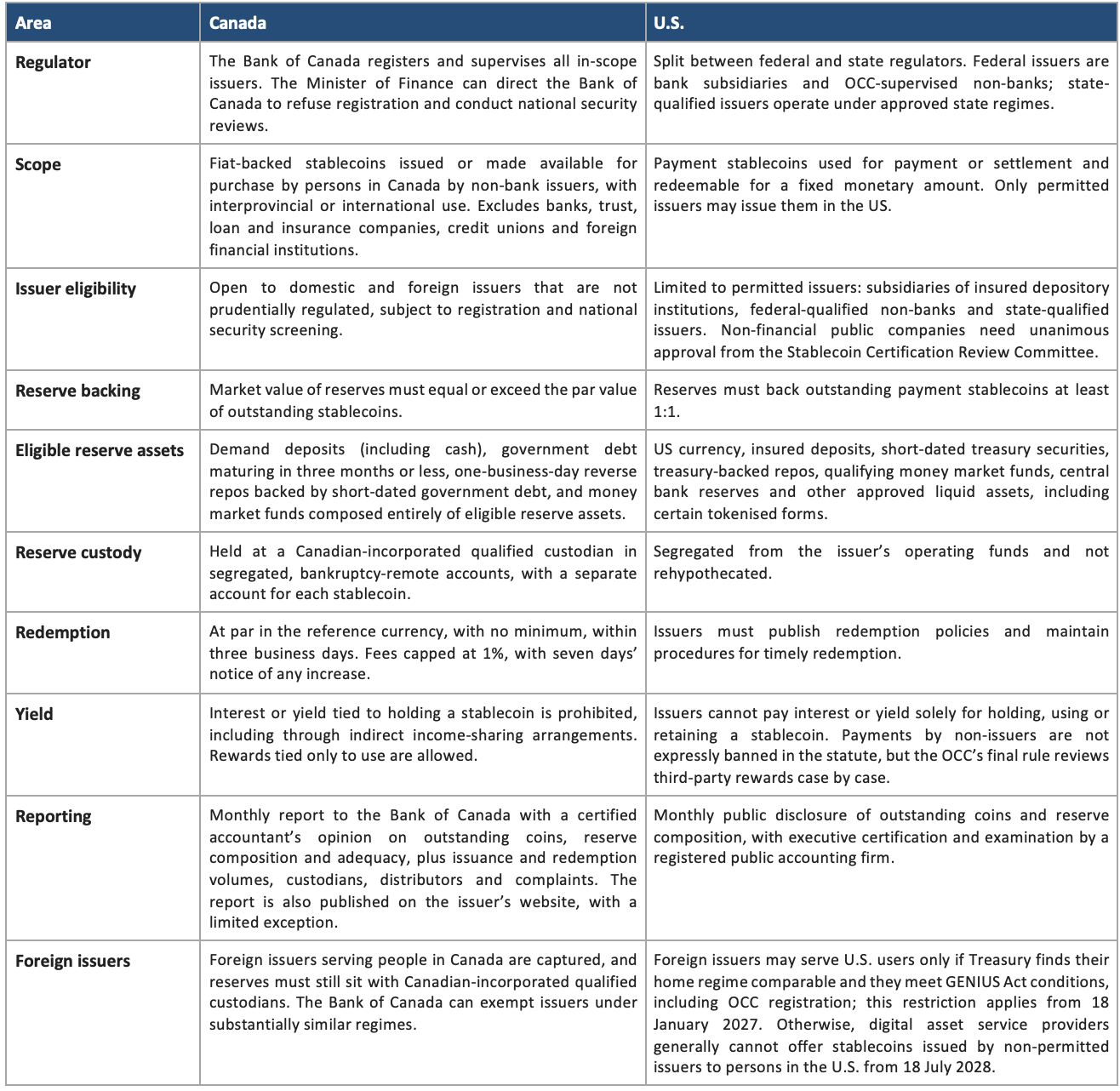
In the United States, the Guiding and Establishing National Innovation for U.S. Stablecoins (GENIUS) Act (S. 1582 (Public Law 119–27)) was enacted on 18 July 2025 and takes effect on 18 January 2027. On 21 October 2026, the Office of the Comptroller of the Currency (OCC) issued a final rule (Bulletin 2026-50 / News Release 2026-92) to implement the GENIUS Act. While the U.S. and Canadian regimes share many of the same principles, with full fiat backing, high-quality reserves, and a restriction on yield, they differ in structure and in how much detail the rules specify. A comparison of the key areas is presented below.
How the Public Consultation Works
When the draft Stablecoin Regulations were published on 24 October 2026, the Canadian Government invited the public to comment on the policies within 60 days. The deadline is 11:59 pm EST on 23 December 2026. After that, the Department of Finance will review the submissions and make any changes it considers appropriate. The final draft then goes to Cabinet and is published in the Canada Gazette, Part II, ahead of the provisionally targeted autumn 2027 commencement.
Anyone can comment, including banks, prospective issuers, payment providers, industry groups, consumer organisations, other regulators and individuals. You do not need to be Canadian or a formal stakeholder. Comments can be submitted through the draft regulations page.
Why Stakeholders May Want to Participate
The consultation is the formal point at which the parties who will operate under these rules can shape them, and previous consultations have demonstrated that public feedback can change the underlying regulations. Several areas of the draft may remain open to challenge, and the banks, custodians and issuers who would apply them are best placed to do so. One example is whether the permitted reserve assets leave issuers with enough liquidity tools, particularly compared with the U.S.
The Bank of Canada will consult on its own guidelines once the regulations are finalised, so views expressed now will help shape those. Canadian stakeholders have a limited window to make sure the new regime is workable and competitive. Comments close at 11:59 pm EST on 23 December 2026.
Note: Both the Canadian and U.S. stablecoin regimes are still evolving. The Canadian draft regulations are subject to public consultation and may be amended; the U.S. GENIUS Act was enacted on 18 July 2025 (effective 18 January 2027), with the OCC final rule issued on 21 October 2026.
For further discussion, please contact us at info@appold.com.