Market Update & Industry News - Week ending 30 October 2026
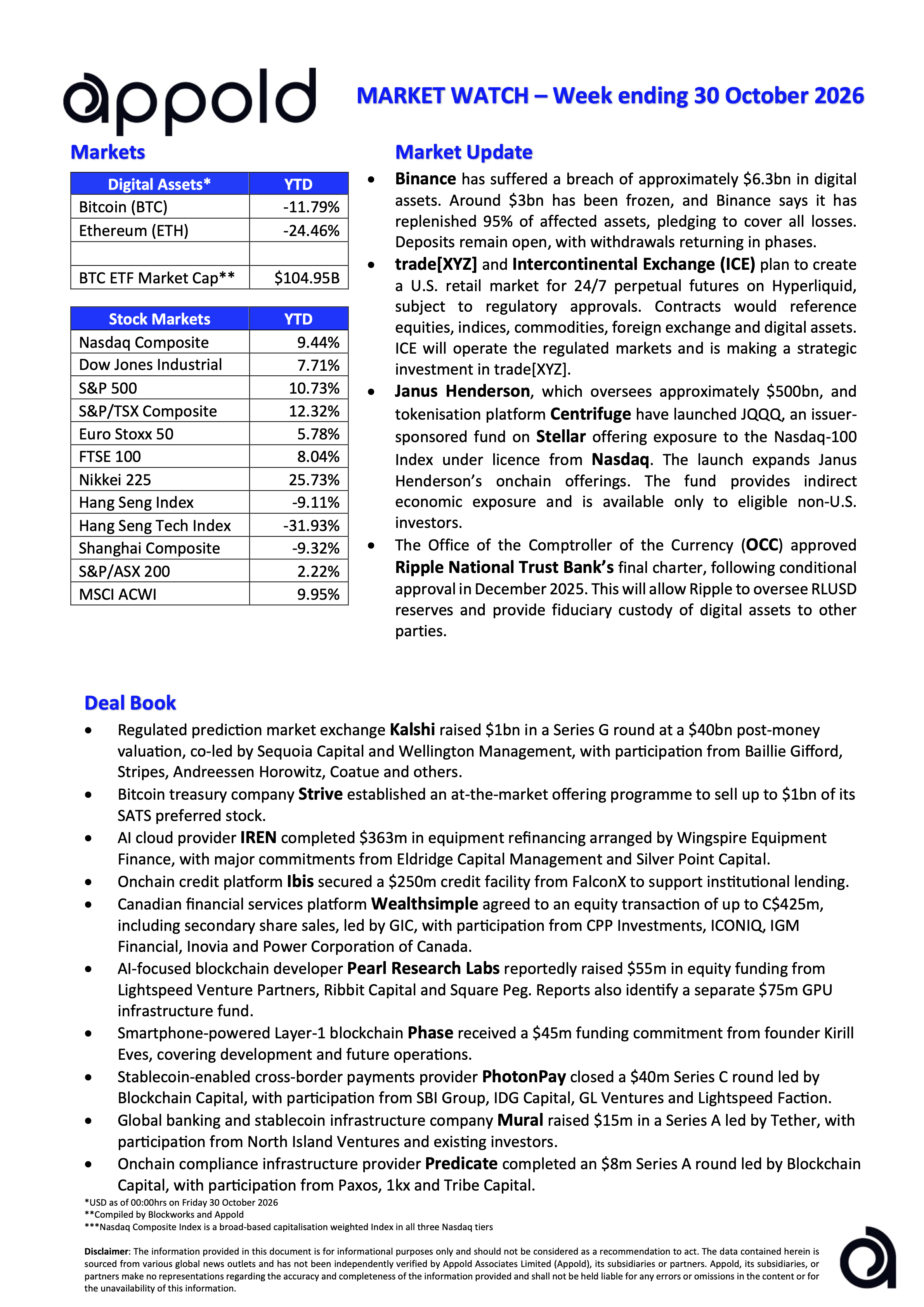
🔷 Binance has suffered a breach of approximately $6.3bn in digital assets. Around $3bn has been frozen, and Binance says it has replenished 95% of affected assets, pledging to cover all losses. Deposits remain open, with withdrawals returning in phases.
Appold View: While the FBI has attributed the hack to North Korean actors, Binance’s investigation has identified additional breach points beyond the initially suspected compromised DevOps laptop. As these attacks continue across crypto and software more broadly, firms seeking to avoid unnecessary risks will need to adopt robust security practices, tighter access controls, and increased due diligence.
🔷 trade[XYZ] and Intercontinental Commodity Exchange (ICE) plan to create a U.S. retail market for 24/7 perpetual futures on Hyperliquid, subject to regulatory approvals. Contracts would reference equities, indices, commodities, foreign exchange and digital assets. ICE will operate the regulated markets and is making a strategic investment in trade[XYZ].
Appold View: ICE’s investment and technology strategy continues to evolve, with this announcement marking a significant expansion into retail perpetual futures. Its choice of Hyperliquid infrastructure and trade[XYZ]’s expertise signals growing institutional interest in onchain markets. Regulatory approval remains outstanding, but the partnership could provide an important route for bringing offshore trading activity into a regulated U.S. framework.
🔷 Janus Henderson Investors, which oversees approximately $500bn, and tokenisation platform Centrifuge have launched JQQQ, an issuer-sponsored fund on Stellar offering exposure to the Nasdaq-100 Index under licence from Nasdaq. The launch expands Janus Henderson’s onchain offerings. The fund provides indirect economic exposure and is available only to eligible non-U.S. investors.
Appold View: Tokenised investment funds are maturing. JQQQ combines institutional investment management with onchain infrastructure, but issuer sponsorship and Nasdaq licensing should not be confused with direct ownership or voting rights in underlying companies. As more traditional managers follow Janus Henderson onchain, synthetic wrappers will find it harder to compete.
🔷 The Office of the Comptroller of the Currency (OCC) approved Ripple National Trust Bank’s final charter, following conditional approval in December 2025. This will allow Ripple to oversee RLUSD reserves and provide fiduciary custody of digital assets to other parties.
Appold View: A major milestone for Ripple. Holding RLUSD reserves under a federal charter should boost trust in the stablecoin, and fiduciary custody puts Ripple in direct competition with traditional banks for institutional clients. It also shows regulators are willing to bring crypto firms inside the traditional banking system.
#MarketWatch #Blockchain #Investments